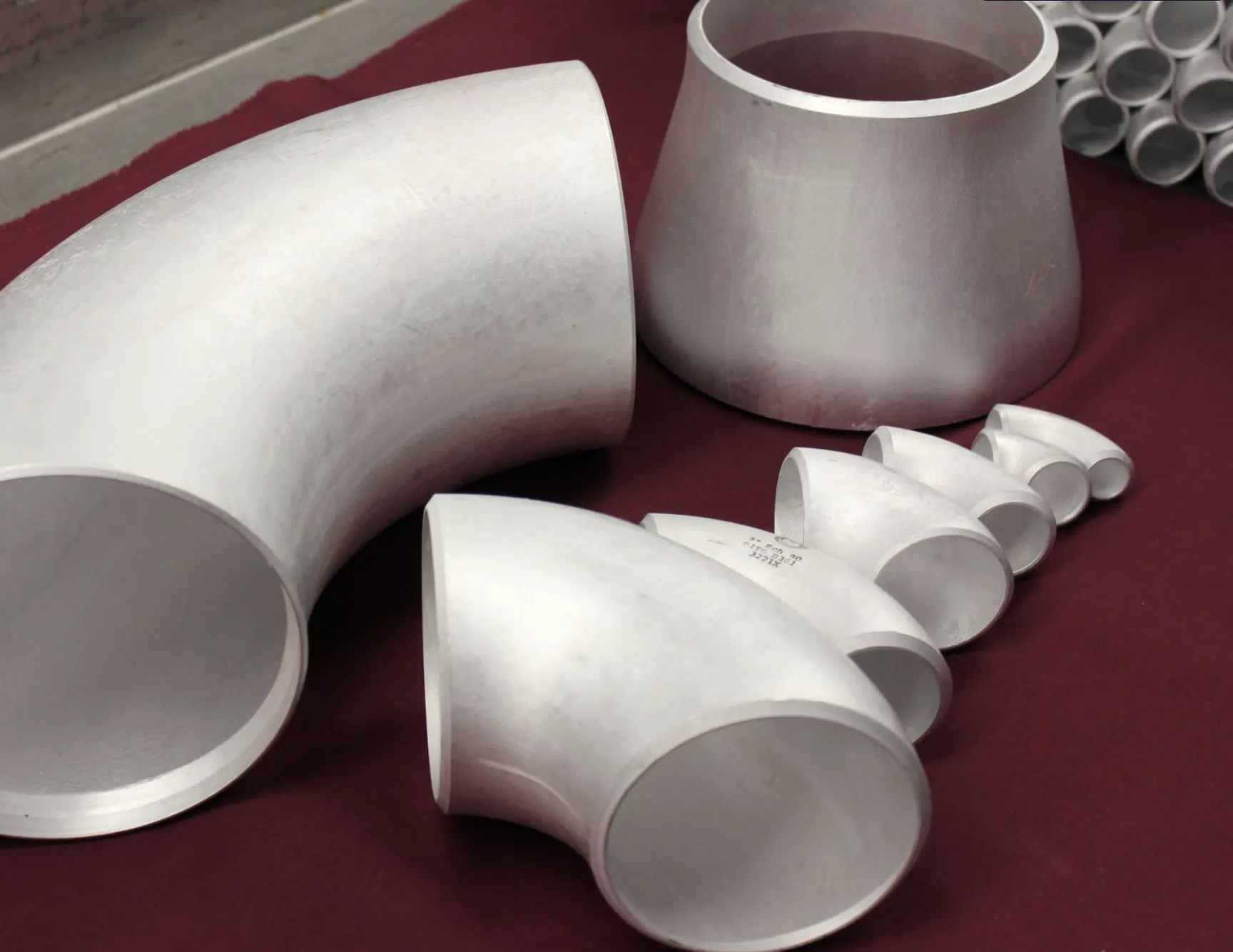
Long-radius and short-radius elbows both change the direction of a piping run, but they do not occupy the same space or create the same geometry. That difference is easy to miss when an order description only says “90-degree elbow.” Before a fitting is selected, the radius needs to be clear alongside the nominal size, wall, alloy, end preparation and drawing requirements.
For many industrial piping jobs, a long-radius elbow is the practical starting point because its broader sweep gives the piping run more room to turn. A short-radius elbow has a tighter bend and can solve a real clearance problem, but it is not simply a smaller version of the same part. It changes the center-to-end dimension and may affect how the next spool, valve, support or equipment connection fits into the assembly.
This guide explains what LR and SR mean, how to compare them, and what to check before including an aluminum elbow in a quote request.
Start with the radius, not just the angle
An elbow is described by more than its turn angle. A 45-degree, 90-degree or 180-degree elbow changes the direction of the run, while the radius describes the shape of that turn. Long radius is commonly abbreviated LR. Short radius is commonly abbreviated SR. Both terms belong in the fitting callout because the radius determines the elbow’s overall geometry.
A long-radius elbow uses a centerline radius of about 1.5 times the nominal pipe size. A short-radius elbow uses a centerline radius of about one times the nominal pipe size. For a 4 in. run, the familiar rule of thumb is a 6 in. centerline radius for LR and a 4 in. centerline radius for SR. The final center-to-end dimension still needs to be checked against the applicable fitting chart, not estimated from a rule of thumb.
The distinction is reflected in the dimensional standards used for factory-made butt-weld fittings. ASME B16.9 covers overall dimensions, tolerances, testing and marking for factory-made wrought butt-welding fittings, including short-radius elbows and returns. Use the standard and project specification as the governing documents, then use published charts as a practical check during selection.
When reviewing aluminum elbow options, begin with the site’s aluminum pipe elbow range. It separates the angle and radius options available from stock, then points to the charts needed for dimensional review.
When a long-radius elbow fits the job
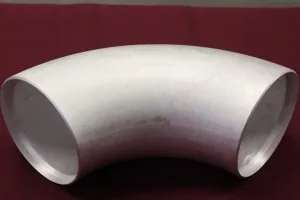
A long-radius elbow has a more gradual turn. That means it requires more space along the run, which is why it cannot be substituted casually into a compact layout. In return, the broader curve is often the sensible choice where the piping route has enough clearance and the designer wants a less abrupt change in direction.
Long-radius 90-degree elbows are common in fabricated piping runs because they give the layout a broad, predictable turn. Long-radius 45-degree elbows are useful when the route needs a smaller direction change, and a 180-degree return may be used where the line must reverse direction. The correct angle comes from the route shown on the drawing. The correct radius comes from the dimensional envelope and project requirements.
Do not reduce the decision to “long radius is always better.” An LR elbow can be the wrong fitting when its larger center-to-end dimension places a downstream component in the wrong location. The question is whether the complete run still works after the elbow is included: the pipe before the elbow, the component after it, the straight length needed for welding, supports, access and any equipment nozzles all matter.
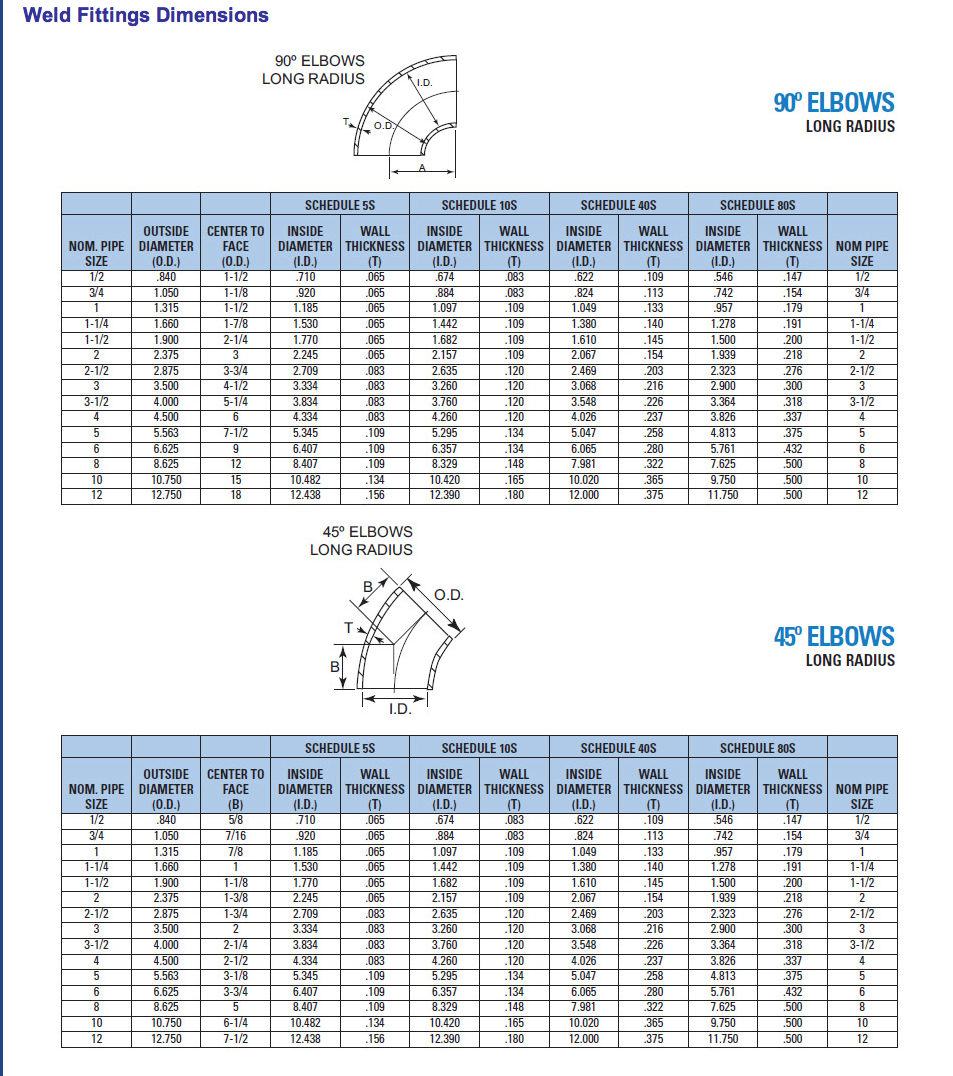
For a first dimensional review, use the long-radius 90-degree and 45-degree chart. It gives the fitting geometry needed to compare the proposed elbow against the available space. Treat the chart as a reference point, then verify the final item against the drawing, material class and issued order documents.
When a short-radius elbow is the better fit
A short-radius elbow uses a tighter centerline radius, so it can reduce the physical footprint of a turn. That makes it useful when a layout has limited clearance, such as a compact equipment connection, retrofit, crowded pipe rack or assembly where the drawing specifically calls for a tighter turn.
The gain in compactness comes with a tradeoff. The line direction changes more sharply, so the fitting should be selected as part of the piping design rather than as a late purchasing substitution. A short-radius elbow can move a companion fitting closer than expected, change weld locations or leave less straight pipe between components. Those effects are especially important on a preassembled spool where one changed dimension can affect the fit-up of the full section.
Specify SR plainly. A request that lists only “90-degree aluminum elbow” leaves the radius open to interpretation. If the job truly needs a short-radius turn, state “90-degree SR,” give the nominal size and wall or schedule, and attach the applicable drawing. That removes a common source of back-and-forth before pricing and fabrication begin.
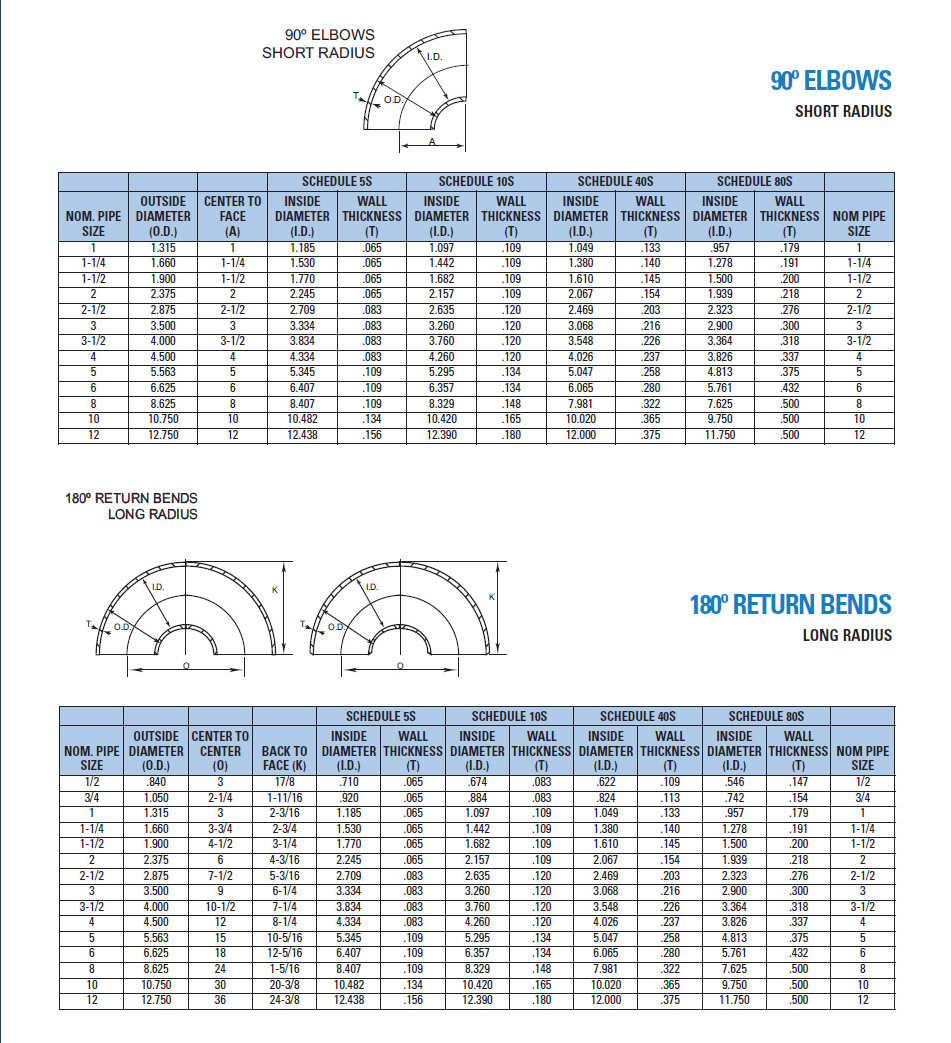
The site’s short-radius and 180-degree dimension chart is the right reference for comparing the compact geometry. It is also useful when the job includes a 180-degree return, where the overall footprint needs to be reviewed with the surrounding run rather than considered as an isolated fitting.
Compare the physical space before comparing availability
The radius choice is often decided by center-to-end dimensions. Center-to-end describes the distance from the face of the fitting to the centerline intersection of the turn. That dimension affects where the outgoing pipe begins. A long-radius elbow extends that location farther than a short-radius elbow of the same nominal size and angle.
Start at the fixed connection. This might be a vessel nozzle, existing pipe, flange, valve, pump connection or a weld point that cannot move. Then trace the route through the elbow to the next fixed point. Check the available straight length, nearby supports, access for welding and inspection, insulation clearance, and any component that needs operating room after installation.
For example, a 4 in. elbow may have the same nominal size at both ends whether it is LR or SR, but the physical route downstream is not the same. A short-radius fitting may make a compact connection possible. A long-radius fitting may place the pipe farther from a wall, support or adjacent line. Neither geometry should be treated as interchangeable just because the size and angle match.
Do this check from the actual drawing. A catalog image cannot show field interferences, and a general dimension chart cannot show the relationship between the elbow and a particular equipment nozzle. For custom work, mark the fixed dimensions and desired orientation on a sketch. That lets the fitting be evaluated as part of the assembly instead of as an unlabeled standalone part.
Keep angle, size and wall in the same callout
Radius is one part of the elbow description. A complete request keeps the bend angle, nominal pipe size, schedule or wall thickness, alloy and end connection together. If one of those details is omitted, the fitting may look right in a list but still be unsuitable at fit-up.
Start with the angle. A 45-degree elbow makes a smaller directional change than a 90-degree elbow. A 180-degree elbow creates a return. Then state LR or SR. After that, give the nominal size and the required schedule or direct wall thickness. A 4 in. LR 90-degree elbow in one wall range is not automatically a substitute for a 4 in. LR 90-degree elbow in another.
For aluminum butt-weld fittings, the material designation matters as well. Aluminum Pipe Fittings lists 5086 H32 and 6061 T6 aluminum fitting alloys. The alloy should follow the project material requirements and the intended service, not a generic preference. Include any traceability, material certificate, testing or inspection requirements when those are part of the job.
The available butt-weld range lists long-radius 45-degree and 90-degree elbows from 1/2 in. through 8 in., long-radius 180-degree elbows from 1/2 in. through 6 in., and short-radius 45-degree, 90-degree and 180-degree elbows from 1 in. through 8 in. Review the aluminum butt-weld fitting range before assuming a configuration is a standard stock item.
Use the applicable standards as a specification check
Standards help establish the language for the fitting, but they do not replace a complete project requirement. ASME B16.9 provides dimensional and product requirements for factory-made wrought butt-welding fittings. It is a useful reference when reviewing the geometry, tolerance and marking expectations tied to a standard fitting.
For factory-made wrought aluminum and aluminum-alloy welding fittings, ASTM B361 covers the material scope for butt-welding and socket-end fittings. ASTM describes the standard as applying to factory-made wrought aluminum and aluminum-alloy welding fittings rather than field-made fittings, and it calls for the alloy and temper to be identified. That is why “aluminum elbow” by itself is not a finished order description.
Use the company’s ASTM B361 reference page as a plain-language starting point, then follow the current project documents and the purchased edition of any required standard. The piping specification may add requirements for construction, examination, testing, material records or end preparation that a basic dimensional callout does not show.
It is also important to separate standard geometry from project approval. A standard chart can help identify the likely elbow shape. It cannot confirm that a particular fitting is acceptable for a unique service condition, a critical weld detail or a constrained assembly. Those decisions belong with the responsible project specification and engineering review.
Consider the piping system, not only the available space
Physical clearance may make one radius easier to install, but it is not the only consideration. A turn changes the direction of the fluid path. The more abrupt short-radius geometry may be appropriate where the design calls for it, while a long-radius turn may be preferred where the route allows a broader transition. The project design should make that decision, particularly on systems where pressure drop, erosion, vibration, solids handling, cleaning access or pump performance are material concerns.
Purchasing should not try to solve a flow-design question by treating radius as a stock preference. If the piping class, process notes or drawing specifies LR, keep LR in the request. If it specifies SR, keep SR. If the documents are silent but the route has tight clearance, raise that constraint early with the engineer or responsible designer instead of changing the radius after the layout is released.
The same caution applies when an existing line is being repaired or extended. Matching nominal size does not prove that an alternative elbow will land in the same place. Review the actual center-to-end dimensions and the components on both sides of the turn. A replacement can require a changed spool length, a different support position or a revised field weld location even when the elbow appears visually similar to the original part.
Maintenance matters too. A tight turn that fits on paper can still be awkward if it places a valve handle, inspection point, drain or removable component against a wall or another pipe. Leave room for access around the complete assembly. The elbows, straight pipe, flanges, supports and insulation should be considered as one installation, not a set of disconnected line items.
Know when the job needs a custom review
Standard elbows are usually the right starting point when the angle, radius, nominal size, schedule, alloy and ends all match a listed fitting. A custom review becomes useful when one of those details falls outside the normal range or when the elbow has to solve a relationship that a standard part cannot hold.
Common examples include a larger diameter, a special angle, added tangents, an unusual center-to-end requirement, modified bevels, a bore transition, a nonstandard wall, or an elbow that has to align with fabricated pipe and flanges in the same spool. These are not details to add after a general quote is issued. They define what is being quoted.
For a custom elbow, send the drawing with enough information to locate the fitting in the assembly. Mark the flow direction where it matters, identify fixed connection points, give the desired orientation, and show all dimensions that cannot move. State the alloy, wall requirement, end preparation, quantity, testing, inspection and material-documentation requirements at the same time. A clear drawing prevents the supplier from having to infer which dimension governs the finished part.
Aluminum Pipe Fittings can support custom fittings, flanges and pipe up to 48 in. That is useful when a project needs more than a stock replacement, but a custom path should be selected because the drawing calls for it, not because a standard fitting was described incompletely. Start with the standard butt-weld range, then use the drawing to show exactly where a custom configuration is required.
Document the final selection before release
Once the correct elbow is identified, carry the full description into the purchase order, bill of materials and any fabrication list. Keep the nominal size, angle, LR or SR designation, schedule or wall, alloy, end details and quantity together. When a fitting is tied to a drawing, include the drawing number and revision so the supplier and fabrication team are working from the same reference.
Before release, compare the requested elbow with the line class and the components immediately before and after it. This is a useful final check for an incorrect radius, missing wall requirement, mismatched alloy or changed center-to-end dimension. It is much easier to correct a line item before material is cut, welded or shipped than to solve an assembly mismatch in the field.
Watch for the common ordering mistakes
The first common mistake is omitting LR or SR. This turns a precise fitting request into a guess and can change the layout. The second is giving only a nominal pipe size without the schedule or wall. A size match does not ensure that the butt-weld ends, bore and wall relationship will work with the connecting pipe.
Another mistake is treating an angle description as a full part number. “90-degree elbow” does not answer whether the elbow is long or short radius, what alloy is needed, whether it is seamless or welded, or what construction and inspection requirements apply. When the line is part of a larger package, send the companion tees, reducers, flanges and straight pipe requirements with the elbow list so the pieces can be reviewed together.
Finally, do not use a chart to approve a custom geometry without a drawing. If the elbow needs unusual center-to-end dimensions, special tangents, modified ends, a nonstandard angle or an offset relationship to another component, provide a sketch or fabrication drawing. That makes the scope clear before a quote is issued.
Prepare a quote request that gets a useful answer
A clear request is faster to review and easier to compare between options. For each aluminum elbow, list the angle, LR or SR designation, nominal size, schedule or wall, alloy, end connection, quantity, delivery location and needed-by date. Add the drawing reference, line number and project specification notes when they apply.
When the elbow is part of a spool or a package of fittings, include the matching components and the dimensional relationship that matters. A short note such as “match existing 4 in. Sch 40 5086 H32 run” can be helpful when it is supported by the drawing. For a custom item, show the branch, tangent, orientation, bevel, bore, machining or inspection details that differ from a normal standard elbow.
How Aluminum Pipe Fittings can help
Aluminum Pipe Fittings supplies 5086 H32 and 6061 T6 fittings from stock in sizes from 1/2 in. through 8 in., with custom fittings, flanges and pipe available up to 48 in. When a routing decision depends on exact dimensions, start with the relevant fitting dimension charts and the published elbow range, then send the drawing and specification details for review.
For a standard elbow, the aluminum pipe elbows page provides the available configurations. For a package or custom fitting, use the quote request page to send the list, drawing, material requirements and timing. That gives the sales team the detail needed to discuss a realistic fitting path.
Frequently asked questions
What is the difference between a long-radius and short-radius elbow?
A long-radius elbow has a broader centerline radius than a short-radius elbow. The long-radius style needs more installation space, while the short-radius style is more compact. The drawing, piping class, available clearance, flow requirements and required dimensions should determine the final choice.
How do I know whether an elbow is long radius or short radius?
Check the line item, drawing, bill of materials or fitting schedule for an LR or SR designation. Do not identify the radius from a product photo or nominal pipe size alone. Confirm the center-to-end dimension against the applicable chart and the actual project documents.
Can a short-radius elbow replace a long-radius elbow?
Not automatically. A short-radius elbow changes the center-to-end dimension and fitting geometry, so it may shift the downstream spool, valve, support or equipment connection. It also changes the flow path. Any substitution should be reviewed against the drawing and piping requirements before material is ordered.
What details are needed to quote an aluminum pipe elbow?
Provide the elbow angle, long-radius or short-radius designation, nominal size, schedule or wall thickness, alloy, end connection, quantity, delivery location and needed-by date. Include the drawing and any required material, inspection or documentation notes when the fitting is custom or part of a fabricated assembly.
Are 45-degree and 180-degree elbows available in aluminum?
The available aluminum butt-weld range lists long-radius 45-degree and 90-degree elbows from 1/2 in. through 8 in., long-radius 180-degree elbows from 1/2 in. through 6 in., and short-radius 45-degree, 90-degree and 180-degree elbows from 1 in. through 8 in. Confirm the final size, schedule, alloy and construction requirement before ordering.