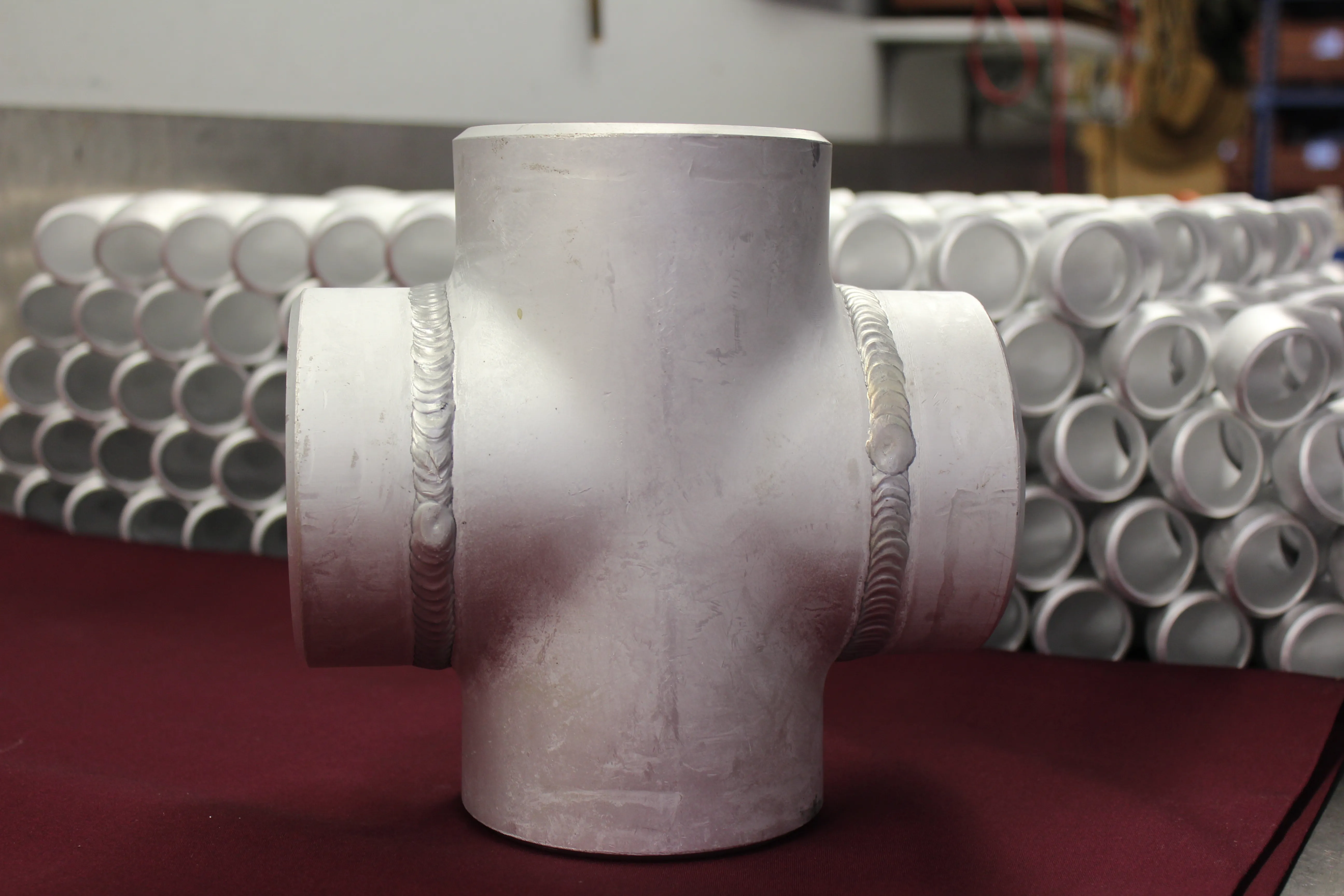
Pipe elbow dimensions matter because an elbow does more than point a line in a new direction. It consumes space, establishes the location of the next pipe end, and has to match the pipe, wall, material, and joining method around it. A request that says only “4 inch elbow” leaves too much open. The same nominal size can have a 45-degree, 90-degree, or 180-degree angle, a long or short radius, and different wall or end requirements.
This guide explains how to read the dimensions that control fit-up for industrial pipe elbows. It is a practical starting point for an aluminum butt-weld requirement, not a substitute for the project drawing or governing specification. Use the drawing to establish the route, then use the matching chart to confirm the geometry before pipe is cut or material is requested.
Start by identifying the elbow you actually need
Before opening a dimension chart, identify four basics: the turn angle, the radius, the nominal pipe size, and the connection type. The angle tells you how far the line changes direction. A 45-degree elbow makes a diagonal turn, a 90-degree elbow makes a right-angle turn, and a 180-degree return brings the line back in the opposite direction. Those are different fittings, even when the nominal size is identical.
The radius is a separate choice. Long-radius elbows make a broader turn. Short-radius elbows use a tighter turn. The selected radius changes the physical space the fitting takes up and the point where the outgoing pipe lands. The pipe route, clearance, support locations, and job specification determine which geometry belongs in the assembly.
Then confirm whether the fitting is butt-weld, socket-weld, threaded, flanged, or another connection style. This article focuses on the chart-reading logic used for butt-weld elbows. The site’s aluminum pipe elbow range and butt-weld fitting range are useful places to compare the available fitting path with the job requirement.
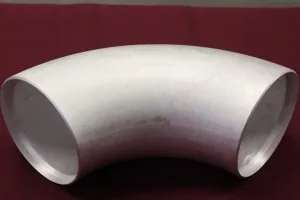
Read nominal pipe size as a designation, not the whole dimension
Nominal pipe size, commonly written as NPS, is the starting label for an elbow. It helps identify the pipe family the fitting is intended to join. It does not by itself tell you the outside diameter at the bevel, the wall thickness, the center-to-end dimension, or the radius. Those physical details are what determine whether the elbow will fit the surrounding spool.
For example, a 4 in. long-radius 90-degree elbow and a 4 in. short-radius 90-degree elbow share a nominal size and turn angle, but their centerline geometry differs. Treating both as just a 4 in. elbow can create a downstream alignment problem. Likewise, a nominal size that matches the connecting pipe still needs a compatible wall or schedule and the correct end preparation for the intended weld.
Read the dimensional table and the drawing together. Use the drawing for the fixed points, route, and connection orientation. Use the chart for the fitting dimensions. Then compare the two against the piping class, material specification, and bill of materials. A chart is a reference tool, not a complete purchase description.
Find the center-to-end dimension before laying out pipe
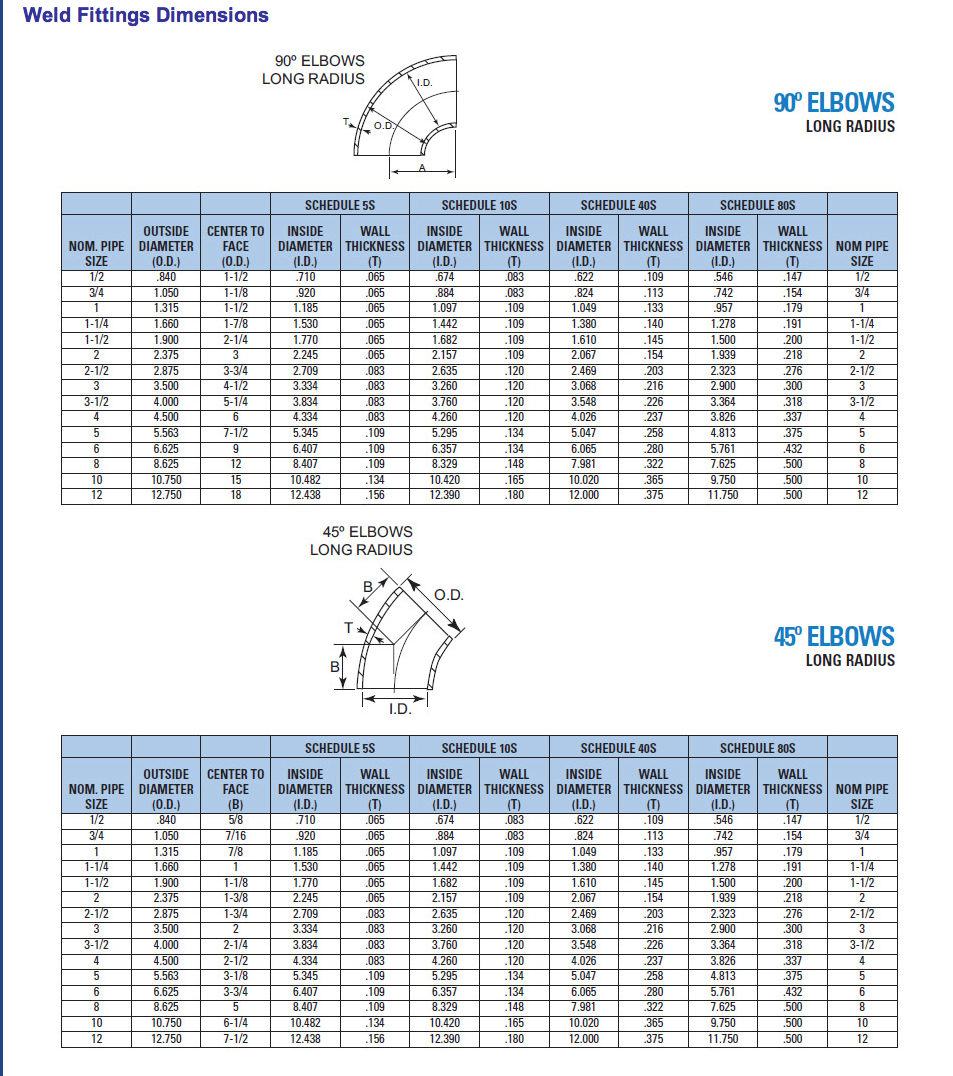
For a 90-degree elbow, the center-to-end dimension is often the dimension that affects layout most directly. It is the distance from the theoretical centerline intersection of the turn to the end face of the fitting. That distance determines where the straight pipe begins after the elbow. It is why a fitting cannot be laid out from angle and nominal size alone.
Use the center-to-end dimension to work backward from a fixed flange face, vessel nozzle, valve, existing weld, support, or equipment connection. If the route turns at a 90-degree angle, establish the centerlines first. Then account for the selected elbow’s listed dimension on both legs of the turn. This gives the spool planner a starting point for the straight-pipe lengths that remain.
On a 45-degree elbow, the same principle applies, but the geometry follows the smaller turn angle. On a 180-degree return, center-to-center and back-to-face dimensions can become important because two parallel legs and the turnaround have to land in a defined location. Read the chart title and the labeled drawing before assuming one letter means the same thing on every fitting shape.
Long radius and short radius are different layout choices
A long-radius elbow is commonly identified as LR, while a short-radius elbow is commonly identified as SR. The names describe the curve of the turn, not a cosmetic variation. A long-radius elbow generally requires more room along the centerline. A short-radius elbow has a more compact path. The correct choice follows the approved design, not a preference for the part that appears shorter or easier to source.
When comparing charts, make sure the heading matches the fitting on the drawing. A long-radius 90-degree chart cannot be used to set the cut length for a short-radius 90-degree elbow. The nominal sizes may look familiar, but the center-to-end values differ. Substituting the wrong radius can move a flange, valve, or second elbow enough to prevent the spool from fitting between its fixed connections.
Where space is tight, do not solve the problem by silently changing the radius. Check the entire route, including weld clearances, support positions, insulation, companion fittings, and access for fabrication or installation. If the layout needs a nonstandard center-to-end dimension, a special angle, or added tangents, it should be reviewed as a custom requirement rather than forced into the nearest standard elbow.
Match the chart to the angle and fitting style
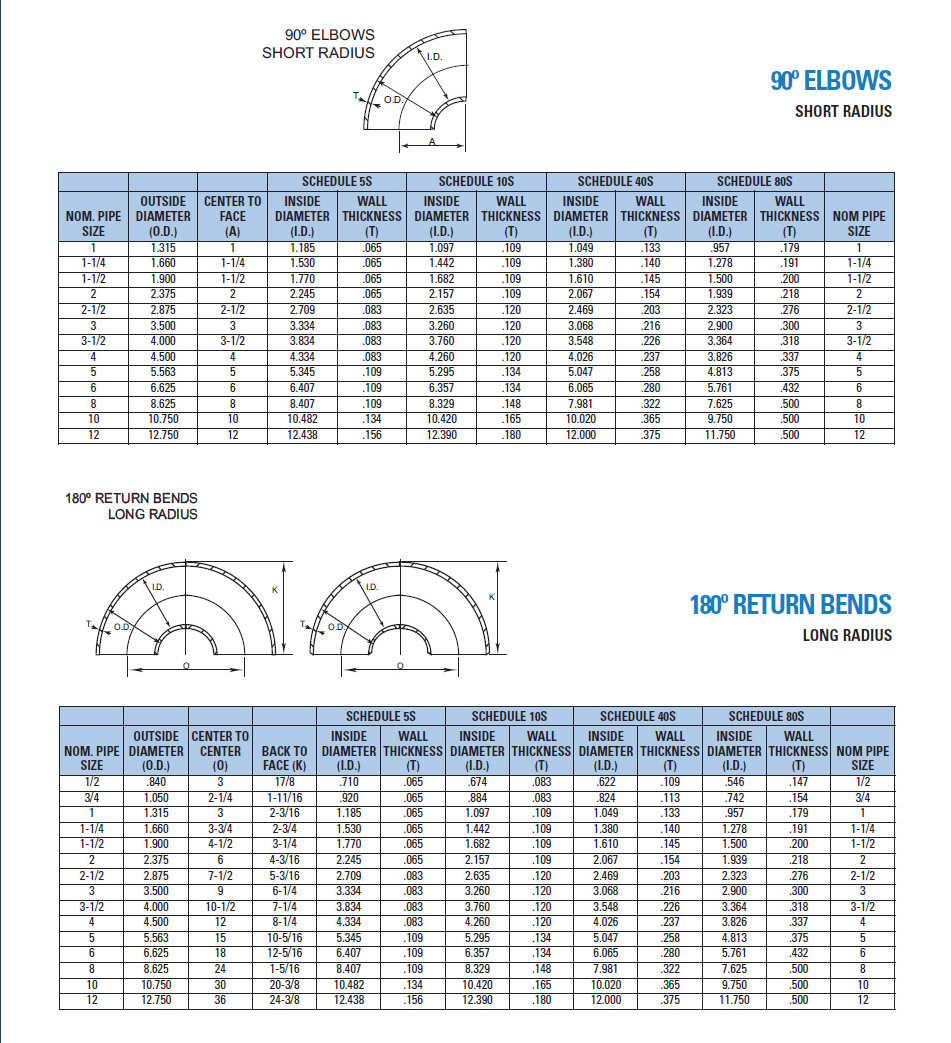
Dimension charts are only useful when the chart matches the actual fitting. A long-radius 45-degree elbow, long-radius 90-degree elbow, short-radius 90-degree elbow, and 180-degree return each have their own geometry and labeled reference dimensions. Start by matching the fitting silhouette and angle on the drawing to the chart, then locate the nominal size row.
For long-radius 45-degree and 90-degree configurations, use the site’s long-radius elbow dimension chart. For short-radius 90-degree elbows and 180-degree returns, use the short-radius and return dimension chart. The broader fitting dimensions page helps when the elbow is only one item in an assembly that also includes tees, reducers, caps, or crosses.
Check the chart’s unit system and the actual project conventions before transferring values to a drawing, cut sheet, or material request. Keep the dimension reference connected to the exact fitting style. A value copied from the correct nominal size but the wrong elbow family is still the wrong value for fit-up.
Wall, alloy, and end preparation complete the fitting callout
Geometry explains where an elbow fits. It does not complete the material requirement. A butt-weld elbow must also be matched to the pipe wall or schedule, the selected aluminum alloy and temper, the weld-end details, and any drawing or documentation requirements. These details affect compatibility with the mating pipe and the job’s material controls.
Aluminum Pipe Fittings lists 5086 H32 and 6061 T6 among its stocked aluminum fitting alloys. The choice should follow the project requirement, service conditions, joining procedure, and any specified material documentation. Review the aluminum alloy information alongside the elbow geometry, rather than adding the alloy after the fitting has already been selected.
For factory-made wrought aluminum and aluminum-alloy welding fittings, ASTM B361 identifies the scope for this class of fitting, while ASME B16.9 describes the standard scope for factory-made wrought buttwelding fitting dimensions, tolerances, testing, and marking. The full project specification remains the controlling source for the final requirement.
Avoid the dimension mix-ups that cause rework
One common mistake is using pipe outside diameter as if it were the elbow’s centerline dimension. Outside diameter describes the size of the connection at the end of the fitting. It does not establish how far the elbow carries the route before the straight pipe begins. Keep end dimensions and centerline dimensions separate when reviewing a chart or laying out a spool.
Another mistake is treating a 45-degree elbow as half of a 90-degree elbow in every respect. The angle is smaller, but the fitting has its own published geometry. Use the 45-degree row and the matching drawing. Do not calculate a takeoff by simply dividing a 90-degree dimension unless the approved design information specifically calls for that calculation.
It is also easy to confuse the fitting’s centerline dimensions with the cut length of the companion pipe. The finished pipe length depends on the whole assembly, including all elbows, straight sections, weld gaps or fit-up allowances, flanges, valves, and fixed connection points. Confirm the fabrication method and drawing conventions before converting a reference dimension into a cut length.
Finally, do not assume a replacement elbow is correct because it occupies roughly the same envelope as the removed item. Record the original angle, radius, nominal size, wall, alloy, ends, and the key measured dimensions. A replacement that is close in appearance but different in centerline geometry can force an avoidable field change.
Use a simple fit-up review before releasing the request
A practical review begins with the two points that cannot move. These may be equipment nozzles, flange faces, existing welds, or a tie-in point. Trace the pipe centerline between them, identify every angle change, and then assign the matching elbow geometry. Record the chart dimensions that establish each takeoff. This makes it easier to see whether there is enough straight pipe for welding and whether the next component lands where it should.
Next, check the mating pipe size, wall, alloy, and end preparation. For an existing system, measure or verify the installed fitting details rather than relying on a visual match. Two elbows can look nearly identical in the field while differing in radius, wall, material, or centerline dimensions. A clear drawing, marked-up photograph, or measured sketch helps eliminate that uncertainty before material is quoted or fabricated.
When to request a custom elbow review
Standard elbows work well when the drawing, route, nominal size, radius, wall, alloy, and ends all match the listed fitting geometry. A custom review is appropriate when the job calls for a nonstandard angle, unusual center-to-end dimension, special tangent length, large size, added machining, nonstandard wall, or a configuration that must align with existing equipment.
Provide the piping sketch or drawing, the connection points that cannot move, the flow direction when it matters, the key dimensions, material requirements, quantity, and any inspection or documentation needs. Aluminum Pipe Fittings can review standard and custom fitting requirements as part of a complete assembly. Start with the listed aluminum butt-weld fitting range, then use the quote request page to send the team the full requirement.
Frequently asked questions
What is the most important pipe elbow dimension?
For a 90-degree elbow, the center-to-end dimension is often the first layout check because it establishes where the downstream pipe begins. It must be read together with the nominal size, angle, radius, wall or schedule, alloy, and end preparation.
Are long-radius and short-radius elbow dimensions interchangeable?
No. A long-radius and short-radius elbow of the same nominal size turn the line through different geometry. Their center-to-end dimensions differ, so substituting one for the other can move the next weld, flange, valve, or nozzle connection.
Does nominal pipe size give the actual elbow size?
No. Nominal pipe size identifies the piping size designation, not every physical dimension required for fit-up. Confirm the charted outside diameter, radius, centerline dimensions, wall or schedule, and the fitting standard or project requirements.
What should be included in an aluminum elbow request?
Include the angle, long-radius or short-radius designation, nominal size, schedule or wall thickness, alloy, end preparation, quantity, drawing reference, delivery location, and needed-by date. Add any inspection, documentation, or custom dimensional requirements that apply.